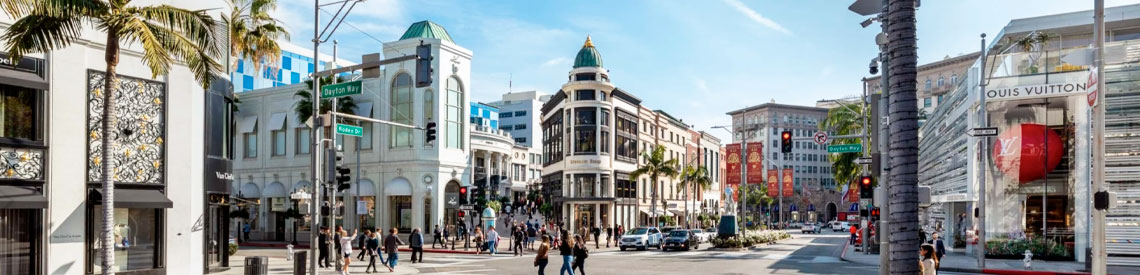
A two-tier retail market is emerging in Los Angeles, where high-performing corridors thrive on scarcity while broader assets compete on stability and value.
Retail Leasing in Los Angeles: A Market Defined by Resilience and Divergence
Los Angeles’ retail real estate market is demonstrating relative resilience and growing investor appeal, particularly as capital shifts away from weaker office and multifamily sectors. While overall retail transaction volume declined sharply after its 2022 peak, the rebound in 2025 signals renewed confidence, largely driven by limited new supply rather than strong pricing growth.
At the same time, rising interest rates are influencing investor behavior across all asset classes, with the cost of capital now a critical component of underwriting and deal structure.
A Two-Tier Market Takes Shape
A clear bifurcation has emerged within the retail sector.
High street corridors such as Beverly Hills and Abbot Kinney Boulevard remain supply-constrained and command exceptionally high prices per square foot, supported by luxury tenants with strong balance sheets. This same dynamic is increasingly evident in emerging high-performing submarkets such as Studio City and the Ventura Boulevard corridor through Sherman Oaks, where landlords continue to achieve elevated rents alongside persistently low vacancy.
Select pockets of Thousand Oaks are also attracting strong tenant and investor interest, reinforcing the broader trend of demand concentrating in high-quality, well-located retail environments.
High Street vs. Core Retail Assets
Transaction activity in premier high street locations remains sparse and inconsistent, making them less reflective of broader market trends.
Meanwhile, larger, non-high street retail assets such as grocery-anchored centers and regional malls continue to trade more frequently at significantly lower price points, driven primarily by occupancy and income stability rather than prestige. Notably, many luxury retailers continue to exit enclosed malls in favor of outdoor formats and well-located strip centers that offer stronger visibility and consumer engagement.
Shifting Leasing Behavior
Leasing dynamics are also evolving.
While demand remains strong in top-tier corridors, tenants, particularly those requiring significant capital investment such as restaurants, are increasingly cautious about committing to long-term leases. This reflects broader economic uncertainty and a more disciplined approach to expansion.
At the same time, certain categories are experiencing sustained momentum, with continued growth in beauty, fitness, and food and beverage concepts driving leasing activity across many submarkets.
The Supply Constraint Driving the Market
Ultimately, the long-term lack of new development remains the central theme supporting retail’s attractiveness.
Even as consumer spending becomes more volatile in 2026, luxury and high street retail markets appear relatively insulated from broader economic fluctuations and continue to behave differently from the wider sector. This divergence reinforces a two-tiered retail landscape defined by scarcity, tenant quality, location, and evolving consumer preferences.
See how these leasing trends could impact your property, investment, or expansion strategy.
Let’s connect and start the conversation.
Sources:
- Catherine Yeh, CoStar Analytics | March 24, 2026 | CoStar – High Street Trends Diverge From Broader Retail Sector
SOURCED BY

Stuart Steinberg
Sales Manager
(818) 697-9376
stuart@illicre.com