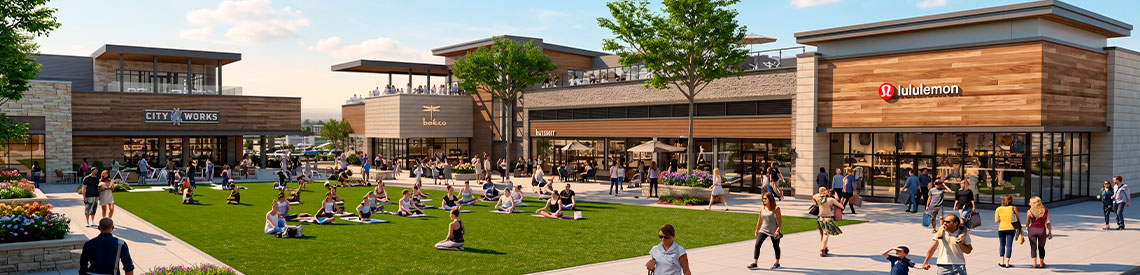
As investors prioritize stability over speculation, retail net lease is re-emerging as a preferred strategy for predictable income, stronger execution, and long-term value.
Net Leased Investment Strategy in a Changing Market: Why Retail Is Gaining Ground
In today’s commercial real estate market, investors keep coming back to the same question:
Where can I find reliable returns without taking on unnecessary risk?
That answer used to be more obvious. Today, it is not.
Interest rates remain unpredictable, tenant demand is shifting, and newer asset classes, such as data centers, are attracting attention. But as more deals get underwritten and more projects move through the pipeline, a clearer pattern is starting to emerge.
Retail net lease is quietly working its way back into favor, especially among investors who care less about chasing upside and more about consistency, scalability, and execution.
At the same time, some of the newer “high-growth” sectors are proving to be more complicated than they initially appeared, particularly in markets like Los Angeles.
What investors are actually prioritizing right now
There has been a noticeable shift in how capital is being allocated.
Recent industry discussions highlighted by GlobeSt point to a broader change in mindset. Investors are not abandoning growth altogether, but they are becoming far more selective about where they pursue it.
Data centers are still part of the conversation, largely driven by AI and digital infrastructure demand. But even then, they often represent a relatively small portion of overall exposure for many operators.
What is gaining traction instead is a focus on:
- Steady income
- Repeatable deal structures
- Operational simplicity
That shift is bringing more attention back to retail, particularly smaller, service-driven assets where demand is tied to everyday consumer behavior.
Data centers: strong demand, but a more complicated path
There is no question that data centers are attracting capital.
Some investors are even moving beyond the assets themselves and looking at companies tied to the supply chain, everything from construction materials to specialized components.
But getting a deal across the finish line is becoming more difficult.
A recent report from CoStar highlighted a proposed data center project in Monterey Park, CA that was ultimately abandoned after community pushback. What started as a redevelopment opportunity turned into a case study in how local resistance can stall even well-capitalized projects.
And it is not just one deal.
Across the country:
- Billions in data center development have been delayed or blocked
- Municipalities are tightening regulations
- Policymakers are starting to weigh broader restrictions
The issue is not demand; it is execution, and in a market like Los Angeles, execution risk matters.
Not all retail is moving in the same direction
One of the more interesting takeaways right now is how differently retail subtypes are performing.
Some categories are holding up well, while others are not.
Service-based tenants, think restaurants, car washes, and childcare, continue to attract investor interest. They are smaller, more flexible, and easier to scale. That combination is hard to find in other asset classes right now.
At the same time, certain niches are going through real stress.
The cannabis sector is a good example. What was once seen as a high-growth opportunity has faced a sharp correction. Pricing pressure, oversupply, and regulatory hurdles have forced operators to adapt quickly, and in some cases, not all have been able to.
That contrast reinforces something important:
Retail is no longer evaluated as a single category. Investors are underwriting the tenant and the business model, not just the property type.
Why retail net lease is standing out again
When you step back and look at the broader landscape, it starts to make sense why retail net lease is gaining traction again.
It is not flashy, but it does have reliable characteristics:
- Long-term leases create predictable income
- Properties tend to align with community needs
- Deals are generally easier to execute compared to more complex asset classes
- The market is widely understood, which helps with liquidity on exit
In an environment where uncertainty is higher across the board, those characteristics carry more weight.
What property owners should be thinking about
For owners, the conversation is becoming more strategic.
It is no longer just about holding or selling, but about positioning.
A few questions are coming up more often:
- Does my asset align with what buyers are actually looking for today?
- Are my tenants positioned to remain stable through different cycles?
- Would repositioning create more value before going to market?
The answers are going to vary from property to property, but the underlying theme is the same. Passive ownership is becoming less effective in a more selective market.
Balancing risk and return in today’s environment
If there is one consistent theme right now, it is balance.
Investors are still interested in growth, but not at the expense of stability or execution certainty.
Data centers may continue to play a role, especially long-term, but they come with added layers of complexity. Retail net lease, on the other hand, offers a more straightforward path in a market that has become anything but straightforward.
Final thought
The market is not necessarily slowing down, but becoming more selective.
Some sectors are expanding, while others are correcting, and even the most talked-about asset classes are facing new hurdles.
What matters now is alignment with demand, with tenant quality, and with the realities of getting deals done.
Understand where your property stands today
Every asset is different, and small shifts in tenant mix, lease structure, or timing can have a meaningful impact on value.
If you are considering a sale or simply want a clearer picture of how your property aligns with current investor demand, we can provide a tailored perspective based on real-time market activity.
Schedule a call with us by filling out the form.
SOURCED BY

Greg Offsay, CCIM
Executive Vice President
(818) 697-9387
greg@illicre.com